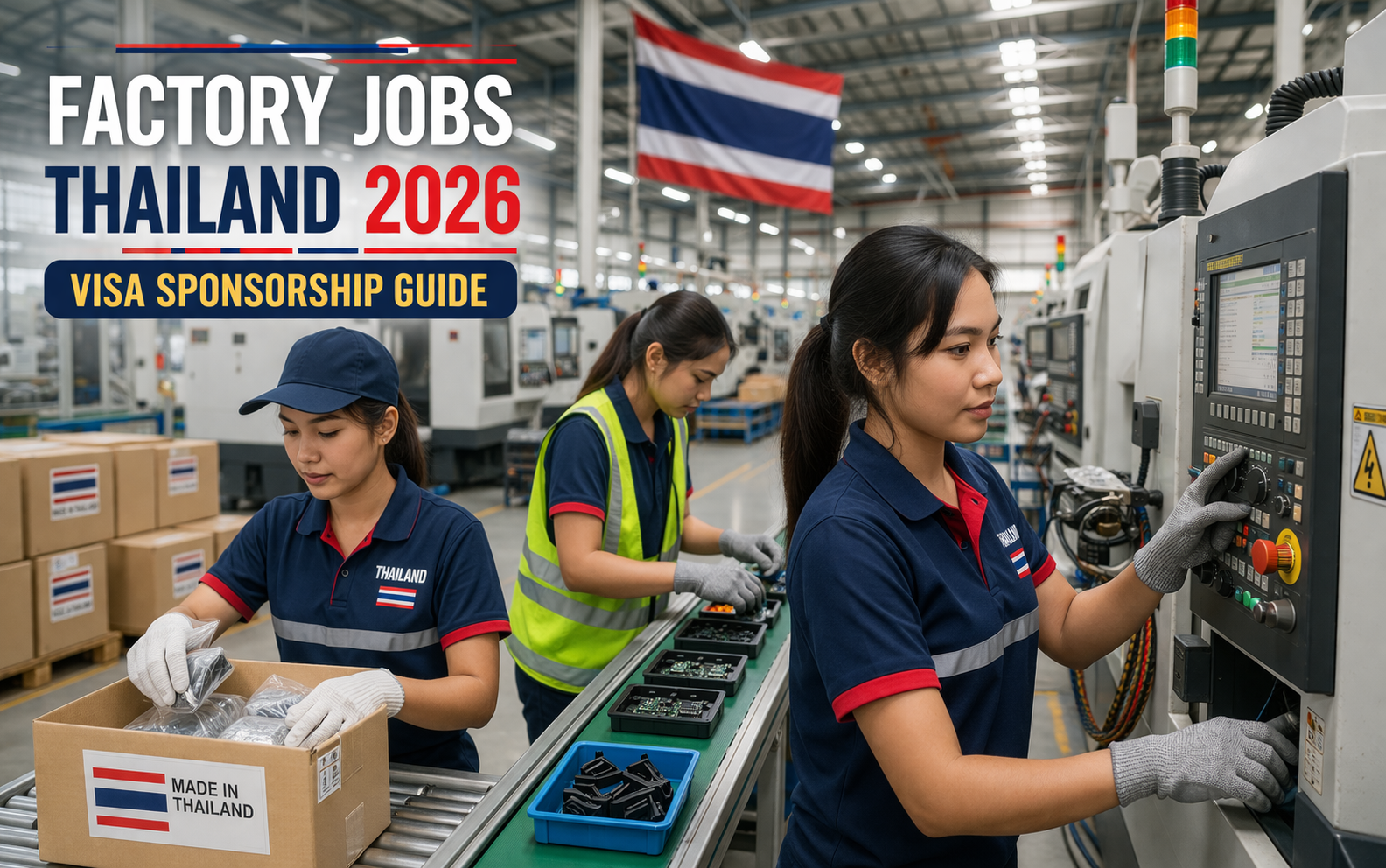
Factory Worker Jobs in Thailand 2026 – Visa Sponsorship Guide
Thailand is among the industrial centres rapidly expanding in Southeast Asia, and it provides good chances of employment to foreigners in 2026. Thailand, with its growing manufacturing industry, growing foreign investment, and growing export demand, is still a country that is appealing to foreign workers, particularly those that work in factories or in production jobs. International applicants are also especially fond of these jobs as they seem to demand minimal education, usually offer a consistent income and can also cover the visa sponsorship.
The employment of factory workers in Thailand can be found in the electronics, automotive, food processing, textile, and packaging industry. Massive industrial belts and export oriented firms engage the services of foreigners to address production needs on a regular basis. In most instances, employers will give accommodation, transportation, and other benefits and these jobs will be appealing to the employees who may want to make and save money.
This ultimate guide tells you all you need to know about factory worker work in Thailand in 2026 – the type of jobs, visa sponsorship procedure, requirements, remuneration, working conditions and professional tips and tricks on how to ensure that you get a job successfully.
Why Will You select Factory Jobs in Thailand in 2026?
- Thailand is a country which has rare mix of low-costs, employment and an emerging industrial economy. The manufacturing industry in the country is still growing and in 2026, thousands of job opportunities will be created in favor of the foreign workers.
- The low cost of living is one of the greatest benefits of working in Thailand as opposed to a lot of other countries. Employees are able to handle their expenses and at the same time save their income. This is very useful to the entry-level employees.
- The other significant variable is access to jobs. Most jobs in factories do not demand any high education level or experience, hence they are easy to undertake by the novices. This enables the foreign workforce to join the work force in a short time period.
- Besides, the industrial areas in Thailand are highly developed and offer good working environment and steady jobs. Other benefits that employers offer include accommodation, meals, and transportation, which lower the cost of living.
- Foreign employees can also adapt and develop their career in the country due to the friendly environment and multi-cultural workforce.
Facts of Factory Worker Jobs in Thailand
- Thailand factory employment is very diverse, with jobs in any industry and production process.
- The workers in the production lines handle the assembly of the products and the use of machinery. The jobs involve attention to detail and work efficiency.
- Packing employees deal with packing and labelling of products to send. These functions prevail in food processing and consumer goods sectors.
- Equipments used in manufacturing are handled by machine operators. There are certain jobs that might need simple training.
- Quality control employees check the products to see that they are up to the mark to be shipped.
- Warehouse and logistics employees deal with storage of goods, loading and distribution of goods within factory grounds.
- Such jobs can be taken up in various sectors hence enabling the employees to be in a position to get the right jobs.
Thailand Visa Sponsorship Factory Jobs
Foreign workers wishing to work in Thailand legally should be given visa sponsorship.
- Employers in most instances sponsor foreign laborers through the application of work permit and visa on their behalf. The procedure includes receiving permission of Thai officials and delivering the relevant documents.
- Non-Immigrant B Visa is the most common type of visa issued to factory workers, and under this type of visa, foreigners are given a chance to legally work in Thailand. After the approval of the visa, a work permit is given, and then the worker can commence to work.
- Most of the paperwork is normally handled by the employer, although the workers are required to produce the right documents and go through the process diligently.
- The concept of visa sponsorship should be understood as one may find themselves in a legal problem because of working without the relevant authorization.
Thailand Factory Worker Jobs (2026) Requirements
The workers should have a minimum qualification to apply to work in factories using a visa sponsorship.
These include:
- Valid passport
- Job offer from Thai employer
- Basic physical fitness
- Willingness to work shifts
- Clean background record
The majority of the factory jobs do not involve formal education, though the basic communication skills can be useful.
Certain functions might have to have experience or technical expertise, particularly when it comes to the running of machinery.
It is more likely that by giving the right documents and fulfilling the jobs, you will get hired.
Wages and Fringe of Thailand factory employment
The wages of factory workers in Thailand differ according to the position, experience and working hours.
Most entry level employees earn 10,000 to 18,000 THB annually. Extrajudicial labor can notably promote the overall income.
Expert employees and operators can attract higher wages on experience.
Besides remuneration, a lot of employers are offering benefits like:
- Free or subsidized accommodation.
- Transportation
- Meals
Health insurance
Overtime pay
Such advantages make living costs lower and aid in saving more money by workers.
The Thai Factories Working Conditions
The factory jobs are physical and the workers are subjected to stringent production rules and safety measures.
Common duties include:
- Operating machines
- Assembling products
- Packing goods
- Cleanliness and safety.
Workers can be asked to work long hours and assume shifts including night shifts.
The safety equipment and training that are normally given by the factories is to guarantee the provision of a safe working environment.
Guide to Factory employment in Thailand (Step-by-Step)
The procedure of applying in factory jobs must be clear and structured.
- Firstly, find the jobs on the verified platforms or recruitment agencies.
- Second, make a professional CV with your skills and experience.
- Third, seek employment that will provide visa sponsorship.
- Fourth, be at interviews in case of shortlisting.
- Fifth, the employer will apply to your work permit and visa once you have been selected.
- Lastly, go to Thailand and do the registration.
Best Thai Cities for Factory Work 2026
- Out there where factories cluster, jobs pop up more often. Take Chonburi or Rayong – factories pack these areas, so openings show up regularly. Instead of guessing, aim for spots humming with production activity. Landing work tends to happen faster near export hubs. Pick wisely, because paychecks grow steadier when you’re close to the action.
- Factories spread across cities such as Bangkok, turning them into busy centers of work. Electronics jobs appear often there, alongside roles in packaging or food processing. Industrial zones fill the area, creating space for production firms to grow. Work options multiply because so many companies settle near the city center.
- Out here in Chonburi, sprawling factory areas shape much of the landscape, especially where car production and heavy industry take up space. Workers from overseas fill many jobs across these sites.
- Factories focused on exports help make Rayong a well-known spot. Its industrial zones add to the appeal, drawing interest from various sectors.
- Ayutthaya offers opportunities in electronics and manufacturing industries, especially for assembly line workers.
- Choosing a place where jobs are easier to find might speed up your search. What matters is matching yourself to locations hiring more people.
Factory Worker Jobs at Major Thai Companies
Folks from abroad often find work here because Thailand hosts a mix of global and homegrown businesses in its factory zones.
- Folks looking for steady work often find jobs at factories run by outfits like Toyota Motor Thailand plus Samsung Electronics Thailand. While these firms build things locally, they also bring in a lot of people to help on the floor. Most hiring happens regularly, so openings pop up now and then without much fanfare.
- Some food processors plus overseas-focused plants bring on staff to handle packing and making goods. Workers find spots in these areas where output needs a steady hand. Not just farms need helpers – factories preparing items for shipment do too. People get hired into lines that move fast, filling orders beyond borders. Packaging jobs pop up alongside assembly tasks when demand crosses seas.
- Factories grouped together under firms such as Amata Corporation tend to draw in many employees, simply because so many businesses operate side by side.
- Bypassing third-party sites by using official company pages or trusted hiring offices boosts the odds of landing real openings. When you skip the middle steps, solid leads show up more often than not.
Average Pay in Thai Factories 2026
- Knowing what you’ll earn helps shape your move overseas. In Thailand, pay at factories shifts based on what you do, how long you’ve done it, also the clock hours you log.
- A person starting out on the production line might take home 10,000 up to 15,000 Thai baht each month. When extra hours are added, pay sometimes climbs past 18,000 baht.
- People who operate machines or work as techs might make more money if they’ve done the job awhile.
- On top of pay, staff sometimes get housing – this cuts costs a lot. Food is provided now and then, helping stretch each dollar further. Getting around becomes easier when rides are covered by the employer instead.
- Fewer dollars come home each month when you work here – yet Thai prices stretch every one further. Bills stay small, so pockets grow.
Common mistakes when applying
- One wrong move early on ruins plenty of applications. Spotting those slipups means sidestepping hold-ups or flat denials later.
- Avoid unknown recruiters when seeking work abroad. Scams pop up often, which means sticking to known job sites and verified companies matters more than ever.
- Documents sometimes go missing. When paperwork lacks details, things slow down because of gaps here and there.
- Visa rules confuse a few people applying, mistakes happen then applications get turned down.
- Later on, missing out on things like pay, where you’ll stay, or how long you work might lead to trouble. What seems small now could become a big deal down the road.
- Before sending anything off, take a moment to double-check every part of that job posting. A closer look at the specifics might reveal what first seemed fine actually isn’t quite right.
Advanced Tips to Get Factory Jobs Faster
To improve your chances of success, follow these strategies:
- Apply to multiple employers
- Focus on high-demand industrial areas
- Prepare a clear and professional CV
- Be flexible with job roles and shifts
- Improve basic communication skills
Workers who follow these strategies are more likely to secure jobs quickly.
Legal Rights of Foreign Workers in Thailand
- Understanding your rights as a worker is essential for working safely in Thailand.
- Foreign workers have the right to receive a legal contract, fair wages, and safe working conditions.
- Employers must provide proper documentation, including work permits and employment contracts.
- Workers are also entitled to basic medical care and workplace safety.
- Employers are not allowed to exploit workers or violate labor laws.
- Knowing your rights helps protect you and ensures a safe working environment.
FAQs
-
Can foreigners apply for factory jobs in Thailand in 2026?
Folks from abroad might find openings on factory floors across Thailand, particularly as 2026 rolls in – need keeps climbing in production zones. Hiring managers often step in with support, arranging visas while guiding applicants through permit paperwork from afar.
-
How much do most people earn working in factories across Thailand?
Folks working in Thai factories usually take home 10,000 to 18,000 baht monthly – pay shifts based on position and how long they’ve been at it. When extra hours come into play, along with perks like housing or food, paychecks grow a bit wider.
-
Do I need experience to work in a factory in Thailand?
Few roles in factories – like packing items, putting parts together, or standing on a line for hours – expect you to show up trained. Still, being able to follow directions, staying on your feet without tiring, plus sticking to odd schedules might get you noticed when they’re hiring.
Final Thoughts
Overseas workers looking for steady work abroad might find factory roles in Thailand a solid fit by 2026, especially since some employers help with visas. Getting one of these positions often depends on how well you plan ahead, learn the paperwork steps, yet stay flexible when applying. A clear approach to searching matters just as much as knowing what documents are needed along the way. Success tends to follow those who prepare carefully, act patiently, while adjusting their methods quietly behind the scenes. Building a future there begins not with luck but with small choices made early and carried through without rush.
From the start, stick to approved methods when applying. Confirm every detail of a job offer before moving forward. Your paperwork must be correct, nothing less. Skip quick fixes – they lead nowhere good. Following rules isn’t flashy, yet it gets you where you need to go. A steady path beats rushing every time.
Sticking with it day after day, life in Thailand slowly shapes what comes next. One choice at a time, showing up matters more than big plans ever did.